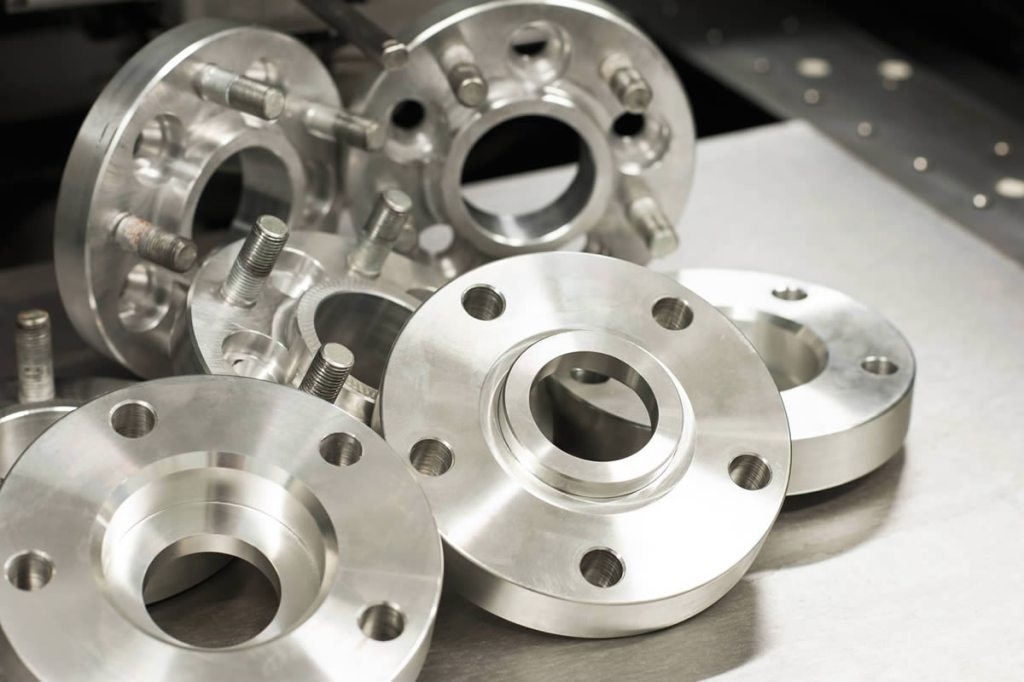
Stainless Steel 304 Flanges / Stainless Steel 304l flanges:

Stainless Steel 304 Flanges

Nitech Stainless Inc is an ISO 9001:2000 certified company engaged in the production of budget-friendly products that conforms to global parameters of design, quality and class. Being sentient towards customers, we have been learning something new through their queries and demands. This process of constant learning has helped us to focus on enhancing our patterns in terms of production and distribution. We are manufacturers, suppliers and exporters of Stainless Steel 304 Flanges which are produced and supplied through a planned and well-executed strategy of swifter consignment packaging and delivery procedure. Our UNS S30400 Stainless Steel Weld Neck Flanges come in a variety of schedules that are able to accommodate the inner diameter of pipes and are easily identified due to the tapered hub that it sports.

They are easily weldable and provide solid welded connections in the gasoline and fresh water tanks. Where temperature fluctuation is a part and parcel of the production process, the weld neck flange comes in handy. Our SS DIN 1.4301 Slip on Flanges are being shipped to African countries on a large scale. Also We offer wide range of Stainless Steel 304l Flanges such as SS 304 Slip On Flanges, SS 304 Weld Neck Flanges, SS 304 Socket Weld Flanges, SS 304 Blind Flanges, SS 304 Orifice Flanges, SS 304 Spectacle Blind Flanges, SS 304 Screwed / Threaded Flanges, SS 304 Reducing Flanges, SS 304 Ring Type Joint Flanges (RTJ) etc.

Standard Specification for Stainless Steel 304 Industrial Flanges

  • Specifications : ASTM A182 / A240 & ASME SA182 / SA240
  • Dimensions : ANSI/ASME B16.5, B 16.47 Series A & B, B16.48, BS4504, BS 10, EN-1092, DIN, etc.
  • Standard : ANSI Flanges, ASME Flanges, BS Flanges, DIN Flanges, EN Flanges, etc.
  • Size : 1/2″ (15 NB) to 48″ (1200NB)
  • Class / Pressure : 150#, 300#, 600#, 900#, 1500#, 2500#, PN6, PN10, PN16, PN25, PN40, PN64 etc.
  • Flange Face Type : Flate Face (FF), Raised Face (RF), Ring Type Joint (RTJ)

Types of Stainless Steel 304 Flanges

Stainless Steel 304 Flanges Application Industries

  • Stainless Steel 304 Flanges for Petrochemical Industry
  • Stainless Steel 304 Flanges for Chemical Industry
  • Stainless Steel 304 Flanges for Oil and Gas Industry
  • Stainless Steel 304 Flanges for Pulp & Paper Industry
  • Stainless Steel 304 Flanges for Power Plant Industry
  • Stainless Steel 304 Flanges for Food Processing Industry
  • Stainless Steel 304 Flanges for Pharmaceuticals Industry
  • Stainless Steel 304 Flanges for Energy Industry
  • Stainless Steel 304 Flanges for Aerospace Industry

ASTM A182 Flange Manufacturer in India

ASTM A182 Flanges
Metal flanges

ASTM A182 Flanges are manufactured with top quality materials in different sizes according to the customer’s requirements. Nitech Stainless is the leading ASTM A182 Flange Manufacturers, Supplier, Dealer and Exporter in India. Nitech Stainless is known worldwide for its extensive high-quality range of ASTM A182 Flanges. At Nitech Stainless we have our own research center to help gather the required knowledge about the latest technologies and keep on increasing the quality of the product with each new research in our research center.

A flange is an external or internal ridge, or rim, for strength, as the flange of an iron beam such as an I-beam or a T-beam ; or for attachment to another object, as the flange on the end of a pipe, steam cylinder, etc., or on the lens mount of a camera or for a flange of a rail car or tram wheel . Thus flanged wheels are wheels with a flange on one side to keep the wheels from running off the rails. The term “flange” is also used for a kind of tool used to form Slip On Flanges. Pipes with ASTM A182 Flanges can be assembled and disassembled easily. Nitech Stainless inc is ASTM A182 Flange manufacturer in India.

Materials used to make ASTM A182 Flanges

ASTM A182 Flanges are available in many different materials. Such as – Stainless Steel Slip On Flanges, Alloy Steel Slip On Flanges, Carbon Steel Slip On Flanges, Aluminium Slip On Flanges, Duplex Steel Slip On Flanges, Hastelloy Slip On Flanges, Incoloy Slip On Flanges, Inconel Slip On Flanges, Monel Slip On Flanges, Nickel Alloy Slip On Flanges, Nitronic Alloy Slip On Flanges, Titanium Slip On Flanges,

Types of ASTM A182 Flange Manufacturers Suppliers Dealers in Mumbai India

Slip On Flanges, Blind Flanges, Weld Neck Flanges, Threaded Flanges, Long Weld Neck Flanges, Socket Weld Flanges, Studding Outlet Flanges, Lap Joint Flanges, Companion Flanges are some of the types of Flanges that we offer at Nitech Stainless Inc.

ASTM A182 Flanges Standard

ASA, ASME, ANSI (USA), PN, DIN (European), BS10 (British/Australian), and JIS, KS (Japanese/Korean).

Factors Used to Identify ANSI Flange Class 300

ANSI Flange Class 300

Whether an ANSI Flange Class 300 will function properly all goes back to whether the flange was the right one for the job in the first place. A flange must fit in pipe joints just right in order for it to perform properly. A small error in choosing a flange can affect an application resulting in a costly mistake. These factors are all involved in choosing the right flange for the right application to maximize its functionality.

  • Types

It’s pretty easy to identify the type of flange by how it looks. First, identify the tops by determining whether a flange has a flat face, threaded bore, lap joint, weld neck, socket weld, or tongue and groove. Next is identifying the bottoms by determining whether it has a flat face, which is completely flat or a raised face which is a slightly raised section on the face of the flange.

  • Size

The size of a flange is comprised of factors that include the standard used (ANSI/DIN/JIS), pressure class needed, and the actual measurements of an ASTM Flange Class 300. Factors include the outer diameter, inner diameter, number of bolt holes, bolt hole diameter, and the bolt circle.

  • Thickness

Thickness play a vital role in identifying a flange by how high of a pressure it can withstand because thicker flanges can withstand higher pressures in an application.

  • Bolt Holes

This component helps determine the size of a flange and pressure class. 3 factors that need to be considered are the amount of bolt holes, pitch circle diameter, and actual size of the bolt holes on a flange. The thicker the bolt the stronger the bolt is, resulting in a higher pressure that the flange can withstand.

  • Standards

There are a number of standards that can be selected from.  The selection will most likely be based upon the application and standards of the other components that this flange will be connected to. (i.e. valves) 3 main standards used are: ANSI – American National Standards Institute, DIN – Detaches Institute fur Norming / European, and JIS – Japanese International Standard. Click here to know more about ANSI Flange Class 300 manufacturer in India.

  • Pressure Class

Pressure class represents the nominal amount of pressure that the product can support or operate under safely.  Each standard has multiple pressure classes available ranging from low pressure tolerance to high pressure tolerance.  The pressure class of products working together should be the same matching the pressure class of the pipes and valves in the system that it is connected to.

  • Materials

It is important to choose the right material for a flange and understand the elements that it will face in an application the piping system is being used. (corrosion, pressure, moisture, temperature) Common materials include steel, stainless steel, carbon steel, and copper nickel.

Consideration on The Stainless-Steel Flanges

This is notable to us that the flange is generally used to intertwine the parts of the bargains together by means of specific electrical discharges welding process. Ordinarily, this is applied to the specialties of valve, gag, tee and other gear. In real, these are explicitly planned by the prerequisites with bunch states of square, rectangular and round to oblige the different necessities and tasks. At the present time, we’ll feature the extremely most flange type – stainless steel carbon steel flanges that are effectively accessible at Nitech stainless Inc – extraordinary compared to other pure ribs providers and producers in India.

Stainless steel is a kind of circle section, one of the most widely recognized in the specialty of pipeline designing. It is utilized two by two. In the business of pipeline designing, the SS spine is mainly utilized for pipe association.

Flanges are utilized to connection up two pieces of apparatus together. Accordingly, it is a basic part, which holds the item set up. This could be an augmentation of the structure, which is utilized to give solidarity to protest. Aside from every one of its uses, the modern ribs are utilized principally for joining funnels, siphons, sheets and different sorts of structures, which require transitional interfacing point.

The same numerous other mechanical sorts of hardware, treated stainless steel flanges of high quality raw material is only accessible at one of dependable carbon steel flanges producers in various kinds so as to suit the differing prerequisites. Look at a portion of these sorts that are clarified beneath:

Weld Neck Flanges: These sorts of backs are the ones that are connected to neck of the pipe. It is welded in a manner by which its thickness is comparable to the elements of the pipe to which it is associated. These sorts of ribs are typically utilized for high-application applications.

Socket Weld Flanges: These are the ones that are utilized as shoulders for the pipe to lay on. It comprises of an external bore, which is utilized to embed the pipe.

Lap Joints: The lap joint is utilized in those applications, which require disassembling all the time. Additionally, they are at the stub end and can be pivoted uninhibitedly.

Size Flange: Such sort of flanges is utilized to append the funnels without welding. The two sizes and configuration rely upon the particulars of the vessels for that it is utilized to interface it.

Tempered steel ribs typically come in various grades and sizes. The various evaluations speak to the standard of characteristics as the steel is expected to agree to. Additionally, they affect the exhibition of steel

To know more about stainless steel flanges and its types visit us.

Classification of Pipe Flanges used in Oil & Gas industries

Stainless steel Flanges are comparatively simple motorized connectors that have been used successfully for high-pressure piping applications. They are well understood, reliable, cost-effective, and readily obtainable from a wide range of suppliers. In addition, the moment-carrying capacity of projections is significant associated to other motorized connectors. This is a significant feature for systems that knowledge pipe-walking or lateral buckling from temperature and pressure variations (e.g. deep-water lines). Flanges can be considered to meet a wide range of submission requirements such as high-temperature and corrosion resistance. 

Operation

Pipe flanges have flush or flat surfaces that are vertical to the pipe to which they attach. Two of these exteriors are instinctively joined via bolts, collars, adhesives or welds.

Typically, flanges are devoted to pipes via welding, brazing, or threading.

Welding joins materials by melting the workpieces and accumulating a filler material. For strong, high pressure influences of similar materials, welding tends to be the most actual method of projection connection. Most pipe flanges are considered to be repaired to pipes.

Brazing is used to connect materials by melting a filler metal which congeals to act as the connector. This method does not melt the workpieces or induce current distortion, allowing for tighter tolerances and clean joints. It also can be used to attach very unrelated materials such as metals and metalized ceramics.

Threading is functional to flanges and pipes to allow the influences to be screwed together in a manner similar to nuts or bolts.

Physical Specifications

First and foremost, a flange must fit the pipe for which it is designed. Physical specifications for flanges include dimensions and design shapes.

Stainless Steel Flange Dimensions

Outside diameter (OD) is the distance between two opposing limits of a flange’s face.

Thickness refers to the thickness of the assigning outer rim, and does not contain the part of the flange that holds the pipe.

Bolt circle diameter is the length from the midpoint of a bolt hole to the midpoint of the opposing hole.

Pipe size is a pipe flange’s consistent pipe size, generally made conferring to accepted standards. It is usually quantified by two non-dimensional statistics, nominal pipe size (NPS) and schedule (SCH).

Nominal bore size is the inner distance of the flange connector. When engineering and ordering any type of pipe connector, it is significant to match the bore size of the piece with the bore size of the breeding pipe.

Type Pressure Capacity Pipe Sizes Applications / Advantages
Blind Very high All Closing pipes, flow pressure testing
Lap joint Low All Systems requiring frequent disassembly
Slip-on Low All Low installation cost, simple assembly
Socket weld High Small Smooth bore for better fluid flow
Threaded Low Small Attachment without welding
Welding neck High All High pressures and extreme temperatures

Materials of Construction

Pipe flanges can be made from various amount of different materials contingent on the piping material and the requirements of the application. Selection depends on factors such as ecological corrosion, operating temperature, flow pressure, and economy. Some of the most communal materials include carbon steel, alloy steel, stainless steel, etc

Carbon steel flanges is alloyed primarily with carbon. It has a high rigidity and strength which increases with carbon gratified, but lowers ductility and melting point. For more information on carbon and stainless steels, please visit the stainless steel flanges manufacturers in mumbai 

Alloy steel flanges is alloyed with one or more fundamentals which enhance or change the steel’s possessions. Common alloys include manganese, vanadium, nickel, molybdenum, and chromium. Alloy steels are distinguished based on standard grades.

Stainless steel flanges are alloyed with chromium in volumes above 10%. Chromium enables stainless steel to have a much-advanced corrosion resistance than carbon steel, which rusts readily from air and moisture exposure. This makes stainless steel better suited for harsh applications that also require high forte

Types of ASTM A105 Carbon Steel Flanges

ASTM A105 Carbon Steel Flange

Carbon Steel Flat Flange Suppliers, ANSI Carbon Steel Blind Flange Carbon Steel Flanges, Carbon Steel EN 1092-1 Flanges, Carbon Steel A105N Weld Neck Flanges Dealer, Carbon Steel Socket weld Flanges Exporter Carbon Steel A105 Orifice Flange, ASTM A105 Carbon Steel Spectacle Blind Flanges ASME SA105 Carbon Steel WNRF Flange, Carbon ASTM A105N SORF Flanges ANSI B16.5 Carbon Steel RTJ Flanges, Carbon Steel Screwed Flanges Stockiest Carbon Steel Long Weld Neck Flanges Stockholder, ASTM A105 Carbon Steel Nipoflange Carbon Steel Ring Type Joint Flanges Manufacturer ASTM A105N Carbon Steel Lap Joint Flanges, ASME SA105 Carbon Steel BLRF FlangeA105 Carbon Steel Square Flanges,  CS ASTM A105 Threaded Flanges Distributors Carbon Steel ASTM A105 Reducing Flanges, Female Flanges A105 Carbon Steel DIN Flanges, Carbon Steel ASME B16.5 Flanges, Carbon Steel A105N Forged Flanges Carbon Steel A105 Flanges, Carbon Steel Slip on Flanges, Carbon Steel Raised Face Flanges, ASME SA105N Carbon Steel SWRF Flange Steel Tongue & Groove Flanges, Carbon Steel Male & Carbon Steel BS 4504 Flanges.

ASTM A105 Carbon Steel Flanges ASTM A105 Carbon Steel Socket Weld Flanges  ASTM A105 Carbon Steel Lap joint Flanges ASTM A105 Carbon Steel Plate Flanges ASTM A105 Carbon Steel Ring Type Joint Flanges ASTM A105 Carbon Steel Spectacle Blind Flanges ASTM A105 Carbon Steel Slip-On Flanges ASTM A105 Carbon Steel Threaded Flanges ASTM A105 Carbon Steel Tongue & Groove Flanges ASTM A105 Carbon Steel Ring Type Joint Flanges ASTM A105 Carbon Steel Square Flanges ASTM A105 Carbon Steel Orifice Flanges ASTM A105 Carbon Steel Forged Flanges ASTM A105 Carbon steel Threaded / Screwed Flanges ASTM A105 Carbon Steel Reducing Flanges Raised Face or Flat Face ASTM A105 Carbon Steel Blind Flanges ASTM A105 Carbon Steel Reducing Flanges ASTM A105 Carbon Steel Long Weld Neck Flanges. 

WAYS TO FIND THE ACCURATE FLANGE FOR YOUR PIPELINE?

There are cases, where you would be in a situation in which your pipeline may stop being functional, either permanently or temporarily. Such kind of issues can nevertheless be fixed up by multiple carbon steel blind flanges dimensions and functional attributes. The blind flanges of different structures are currently obtainable, such as blind flange alloy steel, blind flange carbon steel etc. that can be used for a restoration of a pipeline.

In other verbal, flanges are primarily used as connectors for pipes, pumps and valves; further to which, it may offer an easy access for dissimilar processes such as cleaning, inspection as well as modifications. Flanges are generally composed using two bolts together with the provision of seal.

How the flanges are being put together

The construction of different blind flanges, such as blind flange mild steel and blind flange stainless steel etc. are being constructed using usual method like a typical flange with different mounting holes around their perimeter of the pipes. The flanges can be joint together by putting their faces upwards depending upon the system designs.  In general, different specifications and usage advice is being offered by the supplier. However, experts are suggesting it to be the good idea to acquire blind flanges of different material, within the system while it is being completed.

Thus, it is always crucial to find a proper fit of blind flanges, if in case the repair is needed.

How to find a right fit for it

It is actually very simple to understand the actual application of blind flanges. And the key is to install an appropriately sized piece of flange in order to make sure that the seal is made; this can prevent in between leakages that can happen while the process of sealing is going on. There are various flanges manufacturers in India which provides accuracy in all types of flanges.

Right standard of blind flanges should be used.

While using the flanges of particular standards, the guidelines have to be proposed by the system designer or vessel engineer. Various guidelines have been proposed by the standards about how components are made. Different factors are to be considered, while proposing the use of a particular blind flanges, such as size, pressure, dimension, etc.

It should be noted that many manufacturers follow the guidelines proposed by American National Standards Institute (ANSI) as well as German Institute of Standardization (DIN).

Measurement proposition

It is important to know the right standard of the flanges being used, as it can be helpful to apply the right measurement tools, while deciding what size of flanges can be used. While measuring the flange, it is important to understand while measuring the flange, it should be measured both from outside as well as inside diameter of the pipeline; and precisely inner diameter is important.

Thus, while constructing your own system, any type of pipe flanges can be used with proper measurement of diameter and standards. This can be helpful in repairing commonly manufactured parts.

Flanges types and Flanges uses Application

  1. WELDING NECK FLANGE:

Weld neck flange is the most generally used flange in method piping. It offers the very best level of joint integrity because of Butt-welded with a pipe. These styles of flanges square measure utilized in high and temperature application. Weld neck flanges square measure large & expensive with relevancy alternative styles of flange.

2.LONG Welded NECK Flanges:

The uses for long weld neck flanges are preponderantly on vessels wherever associate degree extended neck is needed. The uses for long weld neck flanges (LWN) square measure preponderantly on vessels wherever associate degree extended neck is needed. This can be deemed to be a specialty flange because of the sticking neck or hub, that acts as a monotonous extension.

3.SLIP-ON flange:

The slip-on type flanges square measure hooked up by Two fillet welds, within still as outside the flange. The calculated strength from a slip-on flange beneath internal pressure is of the order of simple fraction that of Welding Neck flanges, and their life beneath fatigue is regarding simple fraction that of the latter. Normally, these flanges square measure of cast construction, and the square measure has given the hub. Sometimes, these flanges square measure fictional from plates and don’t seem to be given the hub. The disadvantage of the flange is that a mixture of a flange and elbow or flange and tee isn’t attainable as a result of named fittings haven’t a straight finish that completely fell within the slip-on flange.

4.THREADED flange:

Threaded Flanges also are referred to as screw flange, and it’s having a thread within the flange bore which inserts on the pipe with matching male thread on the pipe. This kind of joint association is Speedy and easy however not appropriate for top presser and temperature applications. Threaded Flanges square measure principally utilized in utility services like air and water.

5.SOCKET WELD flange:

Socket-Weld Flanges encompasses a feminine socket within which pipe is fitted. Fillet welding is completed from outside on the pipe. Generally, it’s utilized in tiny bore piping, and solely appropriate for low and temperature application.

6.LAP JOINT flange:

Lap flange has Two elements, a stub end, and a loose backing flange. Stub finish is butt-welded to the pipe and Backing flange freely yield the pipe. The backing rim is of a distinct material than stub material and usually of the steel to save lots of the price. Lap flange is employed wherever frequent activity is needed, and the house is forced.

7.BLIND flange:

The blind flange may be a blank disc with a bolt hole. These styles of flanges square measure used with associate degree other kinds of the flange to isolate the piping system or to terminate the piping as a finish. Blind flanges also are used as a cover within the vessel.

8.Companion Flanges:

A Companion flange may be a flange that encompasses a hub that’s either socket or threaded that you just would attach to your pipe. A pipe flange threaded internally to receive a pipe length and trained therefore it should be fast to a difference like a flange sometimes: an identical arrangement for coupling Two elements of a shaft

9.Studding outlets Flanges:

Studding outlet flanges (also referred to as outlet flanges, stud pads, or pad flanges) square measure created to order things offered during a type of configurations. The foremost unremarkably used studding outlet flange within the trade is the flat bottom sort. We tend to conjointly supply them during a shell mount, head mount, or alternate radius to line the flanges flush along with your tank or vessel. Simply allow us to grasp the radius and kind of mounting needed, and that we can give these flanges consistent with your application. The smallest amount common outlet flange is the tangential mount, that is offset from a centerline and so lacks symmetry. We offer these outlet flanges consistent with your submitted drawing, and though the mounting detail may be a bit a lot of advances, this usually doesn’t have an effect on the time interval compared to the opposite designs.

Different Types of Flanges used in Piping

Stainless steel Carbon steel Flanges

+ Blind Flange: Blind flanges are round plates without center hold used to close the ends of pipes, valves, or equipment. Blind Flange assist in allowing easy access to a line once it has been sealed. They are also used for testing flow pressure. Blind flanges are made in such a way to fit standard pipes in all sizes at higher pressure ratings than other flange types. To know more about other flanges, visit flanges manufacturer in Qatar.

Type: Blind

Pressure capacity: Very High

Pipe Sizes: All

Applications/Advantages: Closing pipes, flow pressure testing

+ Lap Joint Flange: Lap joint flanges are used in piping fitted with lapped pipe / with lap joint stub ends. They can rotate around the pipe to allow for an easy alignment & assembly of bolt holes even after the welds have been completed. Because of this advantage, lap joint flanges are used in systems requiring frequent disassembly of the flanges & pipe. They are similar to slip-on flanges, but have a curved radius at the bore & face to accommodate a lap joint stub end. If you want to buy flanges, visit flanges supplier in Qatar.

Type: Lap Joint

Pressure capacity: Low

Pipe Sizes: All

Applications/Advantages: Systems requiring frequent disassembly

+ Socket Weld Flange: Socket weld flanges are mainly for small-sized and high-pressure piping. Their fabrication is same to that of slip-on flanges, but the internal design of the pocket allows for a smooth bore & better flow of fluid. When internally welded, these flanges also have strength 50% greater than double welded slip-on flanges. To know more about flange type and their different grades visit flanges exporter in Qatar.

Type: Socket Weld

Pressure capacity: High

Pipe Sizes: Small

Applications/Advantages: Smooth bore for better fluid flow

+ Threaded Flange: Threaded flanges are special types of pipe flange that are attached to the pipe without welding. They are threaded in the bore to match external threading on a pipe & are tapered to create a seal between the flange & the pipe. Seal welds can also be used along with threaded connections for added reinforcement & sealing. They are best used for small pipes & low pressures, & should be avoided in applications with large loads & high torques.

Type: Threaded

Pressure capacity: Low

Pipe Sizes: Small

Applications/Advantages: Attachment without welding

Click here to know about applications of Flanges.

BENEFITS OF USING STAINLESS STEEL FLANGES

stainless steel flanges

In industry, flanges form a vital connecting link for piping, valves & other equipment. They provide an easy point of access for cleaning, inspection, modification, & for necessary repairs. A flanged joint provides a strong seal in a closed system, & is made by bolting together a gasket flanked by two flanges. TO know more about stainless steel flanges, visit flanges manufacturer in Kuwait.

In heavy industry, these flanges need to be especially resilient or they can prove to be the weak point in a system. It is important therefore, to ensure that the flanges you are choosing are up to the task.

Why are stainless steel flanges are chosen for industrial use?

In all metal applications, corrosion is a constant consideration. Rust, chemicals & other environmental factors all take their toll on metals. Therefore, the choice of flange would need to be resistant to these factors. Stainless steel outperforms other metal flanges – including carbon steel – due to its high resistance to corrosion. There are world’s top most flanges exporter in Kuwait.

Stainless steel is incredibly strong & durable, capable of withstanding immense pressures. By comparison, aluminum may be a cheaper option but it is softer & not as reliable under heavy stress.

Any system or piece of equipment is only as strong as its weakest part. Joins & welds are traditionally a weak point, so it would be wise to make sure that your choice of metal is correct for the application.

Depending its use, a flange may need to withstand high very temperatures. The correct grade of stainless steel flange would ensure that there is no warping or deformation which would compromise the system. You can find some of the best flanges supplier in Kuwait.

Cheaper, lower grade metal flanges may be fine for certain applications, but if you want your system or equipment to work at maximum capacity, then you should consider spending a little more on stainless steel flanges.

Design a site like this with WordPress.com
Get started